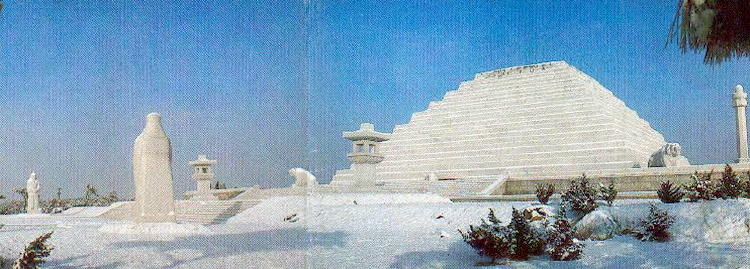
| The Tomb of King Dan-gun (Korea's Original San-shin), Near Pyeongyang in North Korea -- from official postcards purchased there -- |
 |
 |
 |
| An officially-approved 126-member South Korean delegation visited important cultural sites of the Pyeongyang area for 5 days to celebrate the 4335th annual Gae-cheon-jeol [Heaven-Opening Day] (Korea's National Foundation Day; see pages 132-134 of my book) which fell on October 3rd in 2002. This is another positive step towards cultural re-unification. They co-hosted a ceremonial festival at the reconstructed 'Tomb of King Dan-gun' (see page 208). They toured the shrines of several famous mountains, and held a symposium on the legends of and evidence for Dan-gun. He is known as the grandson of the Lord of Heaven, founder of Korea's first Kingdom, a wise Shamanic ruler; he is said to have "retired as a Mountain-spirit", probably of Kuwol-san [Nine-Moons Mountain] SW of Pyeongyang, when Iron-Age Chinese culture conquered his kingdom around 1100 BCE. He is thus sort of the "Father of all San-shin". |
 |
 |
 |
| This is supposedly the original stone monument telling the history of the 'Tomb of King Dan-gun', found at this site with the burried ruins of the original tomb. Two large skeletons are now enshrined inside the reconstruction; they are said to be King Dan-gun and his wife. Pyeongyang authorities have not yet allowed archeologists from South Korea or any other nation to inspect this site, so nothing claimed about it can be considered verified. But it's very interesting how NK's "communist" regime is using this ancient myth to bolster it's own legitimacy, and promote re-unification... |
| This is a typical portrait of King Dan-gun from a temple in South Korea. He sits in a Chinese-style wooden chair with 'rustic' legs, wears a white robe and unadorned crown, and has black hair and beard although he lived for over 900 years (indicating his 'immortal' status, or perhaps it is supposed to be a portrait at the time of his enthronement. He wears a mantle of willow-leaves on his shoulders, and another of some broader leaves around his waist -- these are symbols of "a man of nature", a ruler in primitive time. Throughout this website there are several examples of this motif echoed in a San-shin painting. Two bust-portraits installed at reconstructed Kuwol-san shrines by NK authorities do not include any leaves on his shoulders, however. All these iconograghic elements are borrowed from Chinese portraits of Fuxi, the mythical founder of Bronze-Age Sinitic civilization (and designer of the I Ching Trigrams), a very important deity for Daoists. King Dan-gun is intended as a Korean counterpart of this Fuxi; some Korean nationalists claim that Fuxi IS actually Dan-gun, and the Chinese appropriated him. |